Luxture

FlexiCladd vs Traditional Stone: 5 Reasons to Upgrade

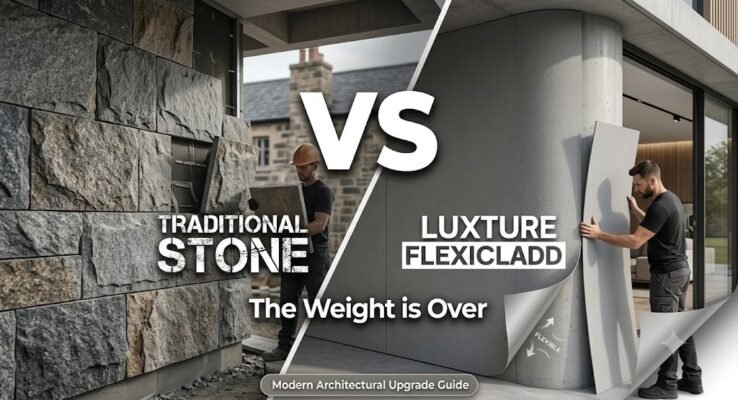
Visual comparison of heavy traditional stone cladding vs lightweight Luxture FlexiCladd on a curved surface

FlexiCladd vs Traditional Stone: The Ultimate Cladding Comparison for Modern Architecture

Introduction: When designing a premium exterior facade or a sophisticated interior statement wall, the choice of material defines both the aesthetics and the structural integrity of the building. For decades, natural stone has been the default choice. However, modern architectural demands are shifting. In the debate of FlexiCladd vs Traditional Stone, architects and builders are increasingly looking for solutions that offer the beauty of stone without its heavy limitations.

Enter Luxture FlexiCladd, a revolutionary flexible wall cladding solution. If you are struggling to choose the right material for your next project, this comprehensive comparison will help you make an informed decision.

The Head-to-Head Comparison: FlexiCladd vs Traditional Stone

To understand why the industry is evolving, let’s compare these two materials across the most critical architectural factors:

Feature Luxture FlexiCladd Traditional Stone
Weight Ultra-lightweight
(Reduces structural dead load)
Extremely heavy
(Requires strong structural support)
Flexibility Highly flexible
(Easily wraps around curved walls & pillars)
Rigid
(Cannot be bent; difficult for non-linear surfaces)
Application Speed Fast and seamless application Slow, labor-intensive cutting & fixing
Crack Resistance Bridges minor hairline cracks due to high elasticity Prone to cracking & chipping under structural movement
Wastage Minimal to zero wastage High wastage during transportation & cutting

4 Reasons Why Luxture FlexiCladd Outperforms Traditional Stone

1. Zero Structural Compromise (Lightweight Advantage) Heavy natural stone adds immense dead weight to a building’s structure, which often requires additional reinforcement. In the FlexiCladd vs Traditional Stone comparison, FlexiCladd wins comfortably for high-rise elevations. It provides the rugged, natural texture of stone but in a lightweight format that is significantly safer and easier to handle.

2. Absolute Creative Freedom on Curved Surfaces Traditional stone is rigid. If your design features curved walls, arches, or cylindrical pillars, stone cladding becomes a costly and complex nightmare. Luxture FlexiCladd effortlessly bends and wraps around complex architectural shapes, allowing designers to execute their vision without compromise.

3. Cost-Effective and Faster Turnaround Time is money in construction. Installing natural stone requires heavy machinery, skilled stone-cutters, and time-consuming wet-work. FlexiCladd offers a faster, cleaner application process, drastically reducing labor costs and project timelines.

4. Weather and Crack Resistance Buildings expand and contract with temperature fluctuations. Rigid stone cannot absorb this movement, leading to eventual mortar failure or cracked tiles. Luxture FlexiCladd is engineered with elastomeric properties, allowing it to flex with the substrate and maintain a flawless, crack-resistant finish for years.
The Verdict: Which Should You Choose?

While traditional stone holds its ground for heritage or rustic applications, modern architecture demands innovation, speed, and adaptability. When weighing FlexiCladd vs Traditional Stone, Luxture FlexiCladd emerges as the superior, future-ready choice for contemporary facades, commercial buildings, and intricate interior designs.

Ready to upgrade your architectural surfaces? Visit www.luxture.com to explore the complete range of FlexiCladd textures or get in touch with our technical team for your next big project.

Leave a comment

All fields marked with an asterisk (*) are required

Have any question?

Write a Message